
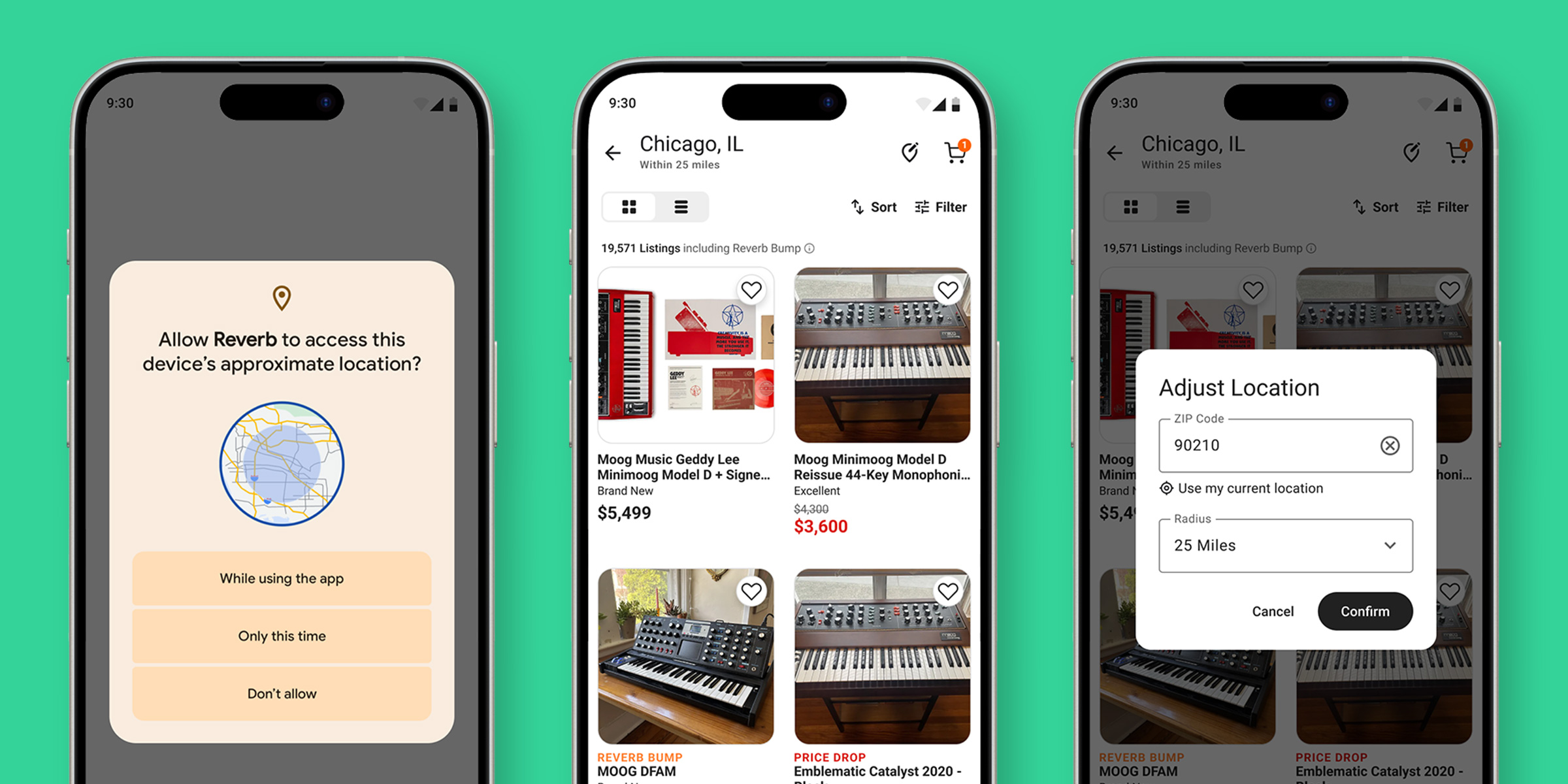
Reverb
Reducing Friction in Location-Based Shopping
Context
Whether they want to try a guitar before they buy it, avoid expensive shipping costs on large items like amplifiers, or pick up an instrument the same day, local listings are an essential part of how many people buy on Reverb.
While Reverb’s mobile app included a dedicated local shopping section, the experience hadn’t kept pace with user needs. As part of the Discovery Experience team’s broader mission to address search UX debt, I set out to rethink how local shopping worked on our app to make it more intuitive, accessible, and dynamic for our users.
The Problem
For one, the local shopping experience was walled off from the rest of Reverb’s search ecosystem. It also required a user to manually enter their city and state information, and even then results were limited to listings in that exact city.
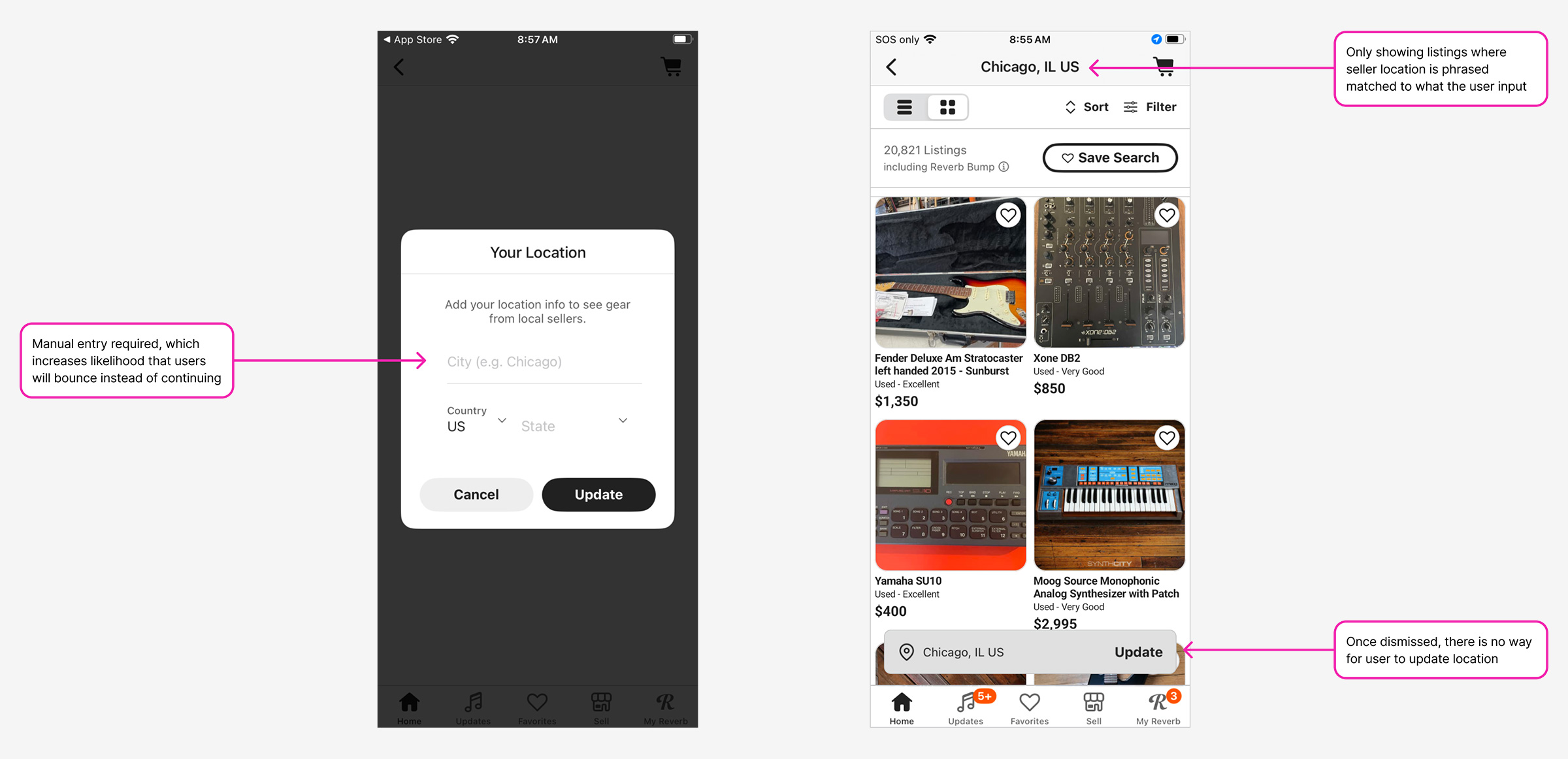
This was especially frustrating for users in suburban or smaller markets, where the gear they were looking for might be just a few minutes away in a neighboring town, but completely invisible in the app.
Although local pickup represented a relatively small share of total orders, complaints about the local shopping experience surfaced consistently in App Store reviews and UXR feedback, signaling a clear gap between user expectations and what our product was delivering.
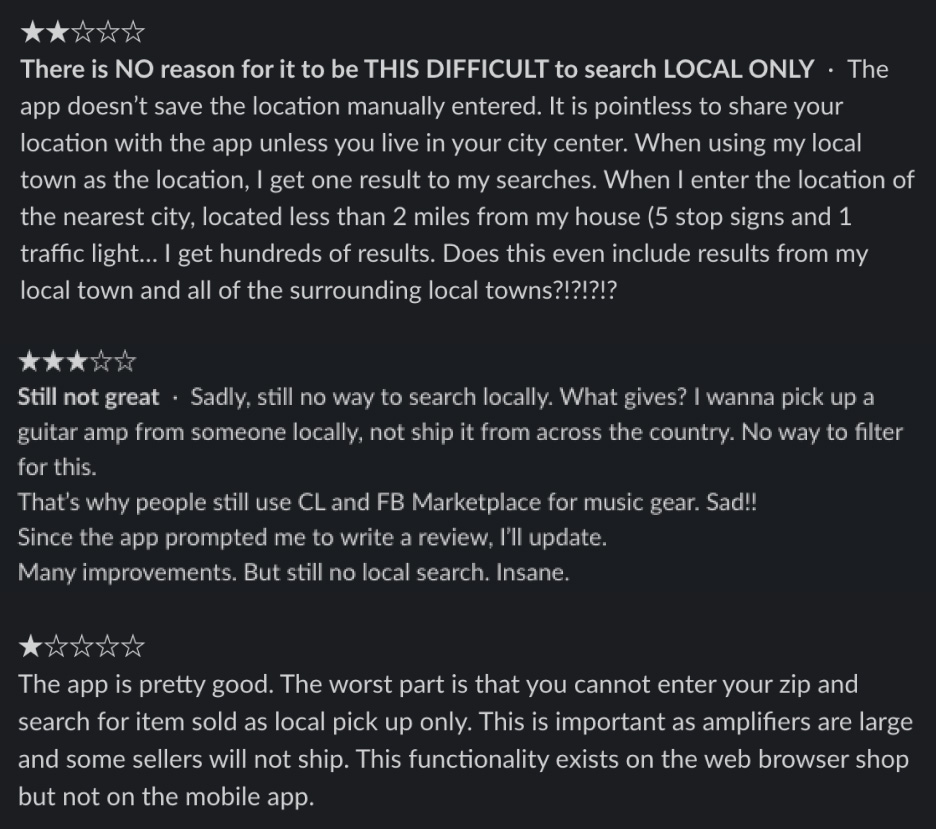
Understanding Local Shopping Behavior
The initial scope for this project involved simply modernizing the way we collected user location data and used this to surface items in the local listings listings section of the app. While this would be a significant improvement to the existing experience, I believed that we could do more to integrate local shopping into the broader marketplace and buying flow.
From a combination of user research, and my own experience as a local gear buyer, I knew that there are multiple ways location-based shopping can fit into the buying experience:
Local-first browsing: some users just want to see all the listings in their area, without much concern for finding specific items, as a way to find deals and even just window shop. This was the type of shopping behavior facilitated most by the existing experience, but mostly seen in our power users.
Item-first, local-second: here users will start by searching within categories, brands, or for specific items, and then choose to see if any of their results are local to them. While this behavior was supported on web with a location filter, it was completely absent from the mobile app.
Discovering local shopping: many Reverb users are not aware that an item is close to them, or has the option for local pickup until late in the buying funnel, and we did not do a great job of educating users about local shopping. I believed that by surfacing some signals in the search funnel, we could help more users discover the joy of local gear, and increase conversion.
I partnered with my teammates in Product and Engineering to make sure tackling these additions to the update would be feasible given the team’s limited bandwidth, and we decided to build out each piece in sequence instead of all at once.
Guiding Design Principles
As I began to redesign the experience, I focused on two guiding usability principles:
First, local shopping should be easy. Modern mobile apps are expected to leverage device location seamlessly, and requiring users to manually enter their location information introduced unnecessary friction at the very start of the experience.
Second, location search needed to be flexible. Many Reverb users are working musicians who travel frequently, and I wanted someone playing a gig in one city to be able to quickly find a replacement snare drum to pick up at the next stop on their tour, without having to dive into their profile settings.
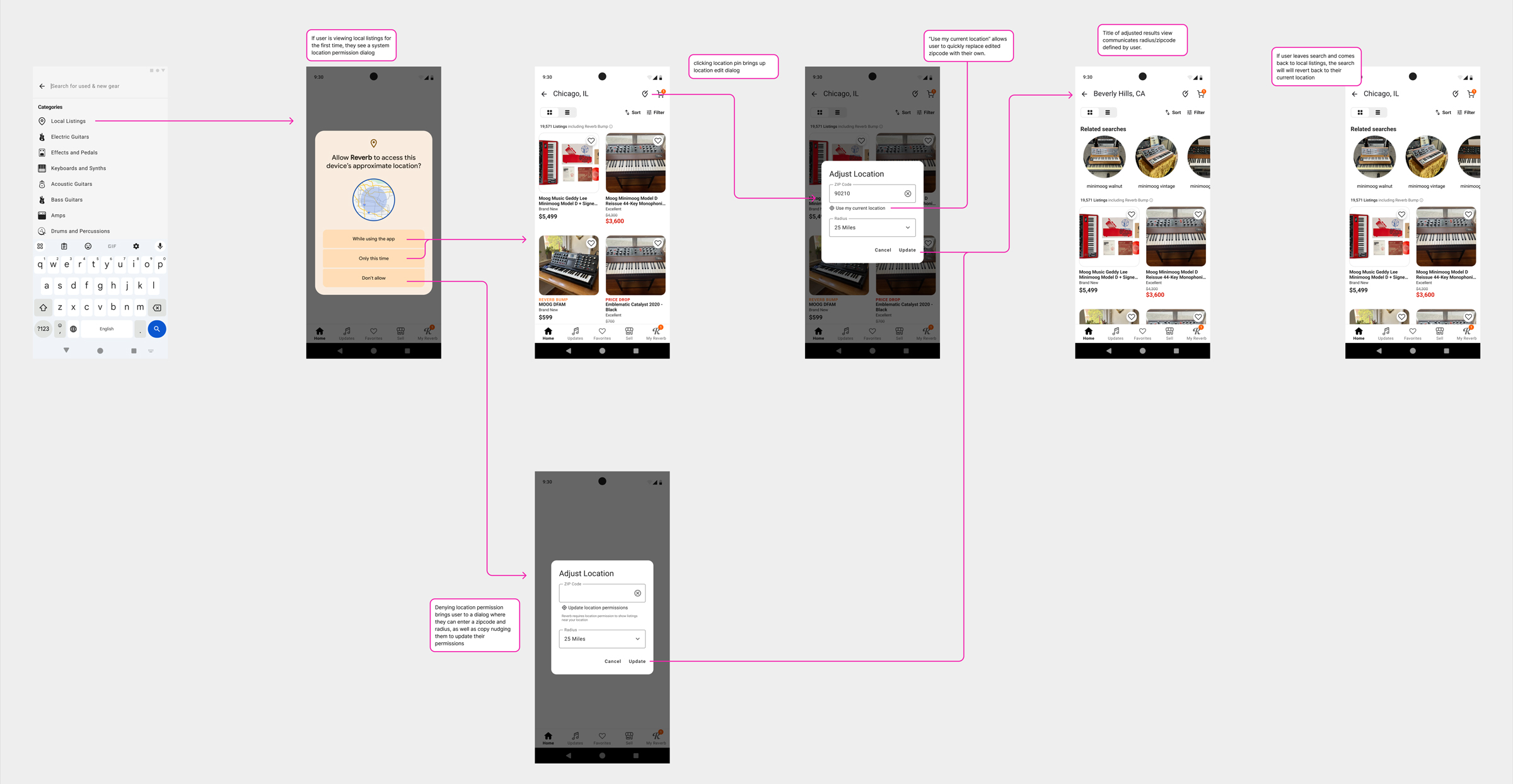
Updating the Local Listings Flow
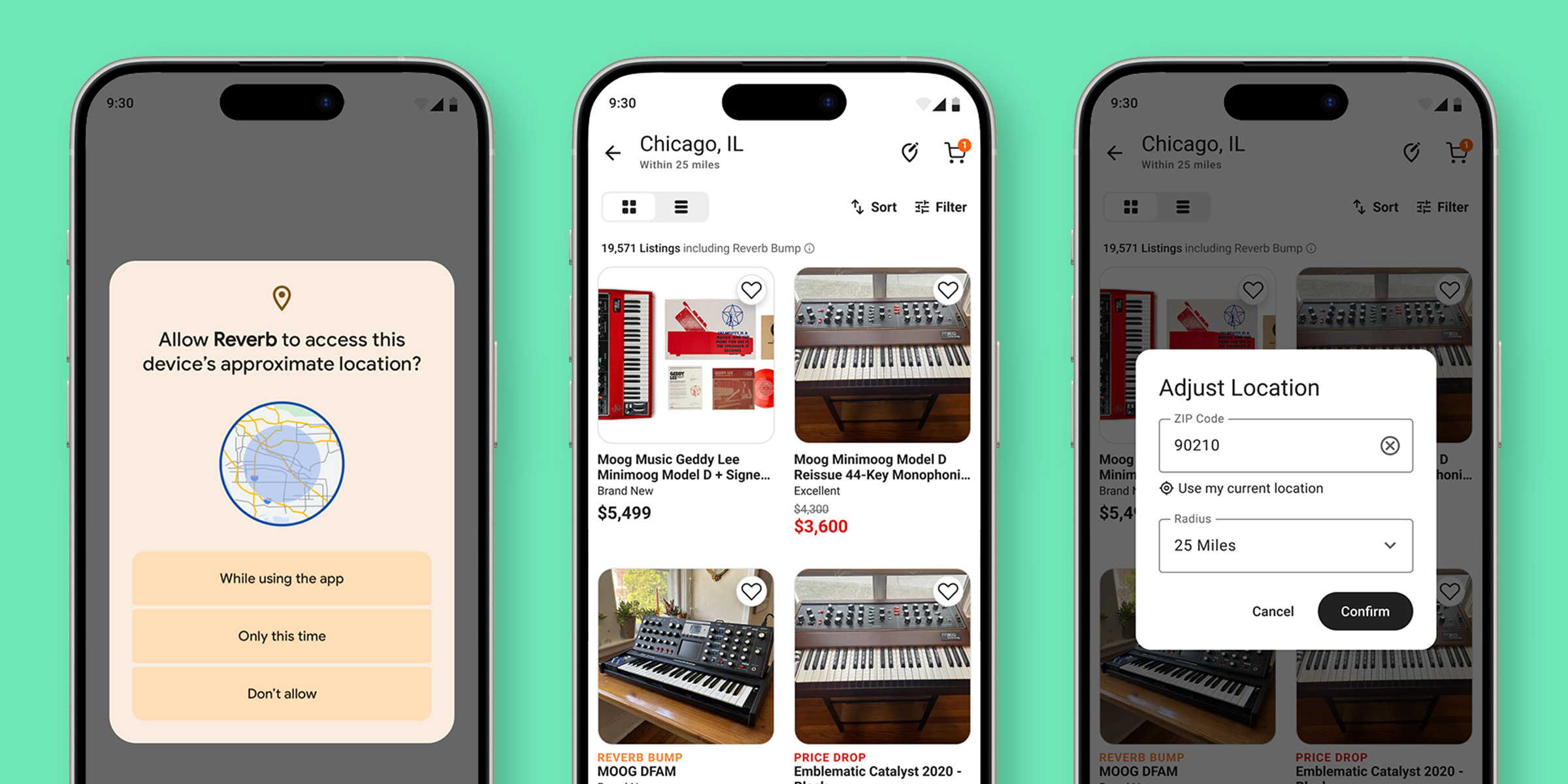
I redesigned the core local shopping flow with a set of lightweight, interconnected updates that removed friction while preserving user control: introduced a system-level prompt to share device location enable local results without effort, a persistent location icon button in the page header that allowed users to quickly view or change their location at any time, a manual location entry dialog for users who preferred not to share device data, and a radius selector that made it easy to browse nearby listings beyond city boundaries.
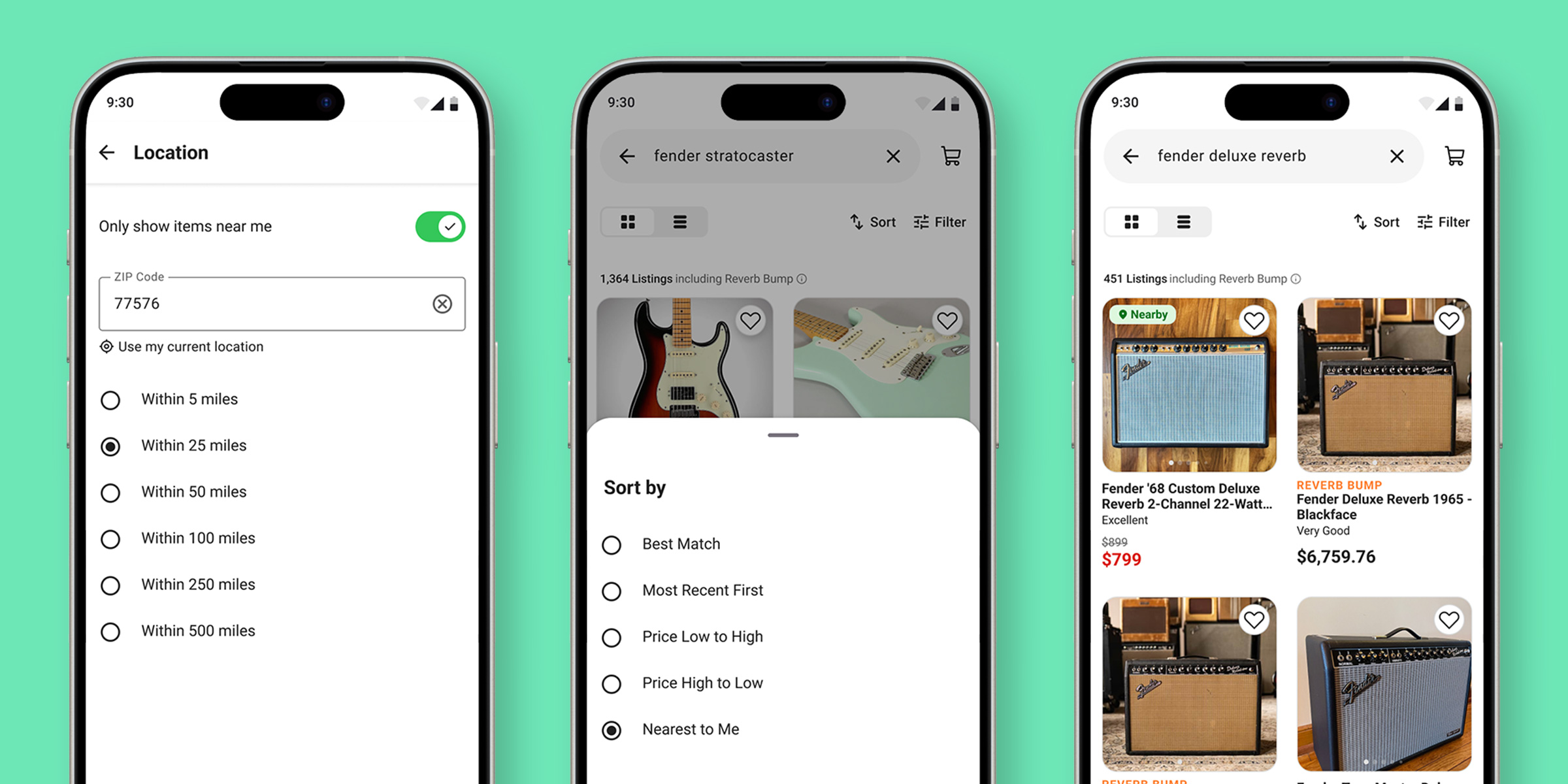
With that second type of local shopping behavior in mind, for users who think item-first and local-second, we also integrated location proximity filter and sorting methods into the core Reverb search experience, allowing users to get similar benefits without having to choose to do location-based shopping from the start.
And to help users discover items near them when they haven’t considered local shopping, I developed signals to communicate that an item was nearby earlier in the search and discovery process. While we saw strong potential in this last aspect of the work, we decide to shelve it until later as we were planning on a larger scope of search signal work.
Launch
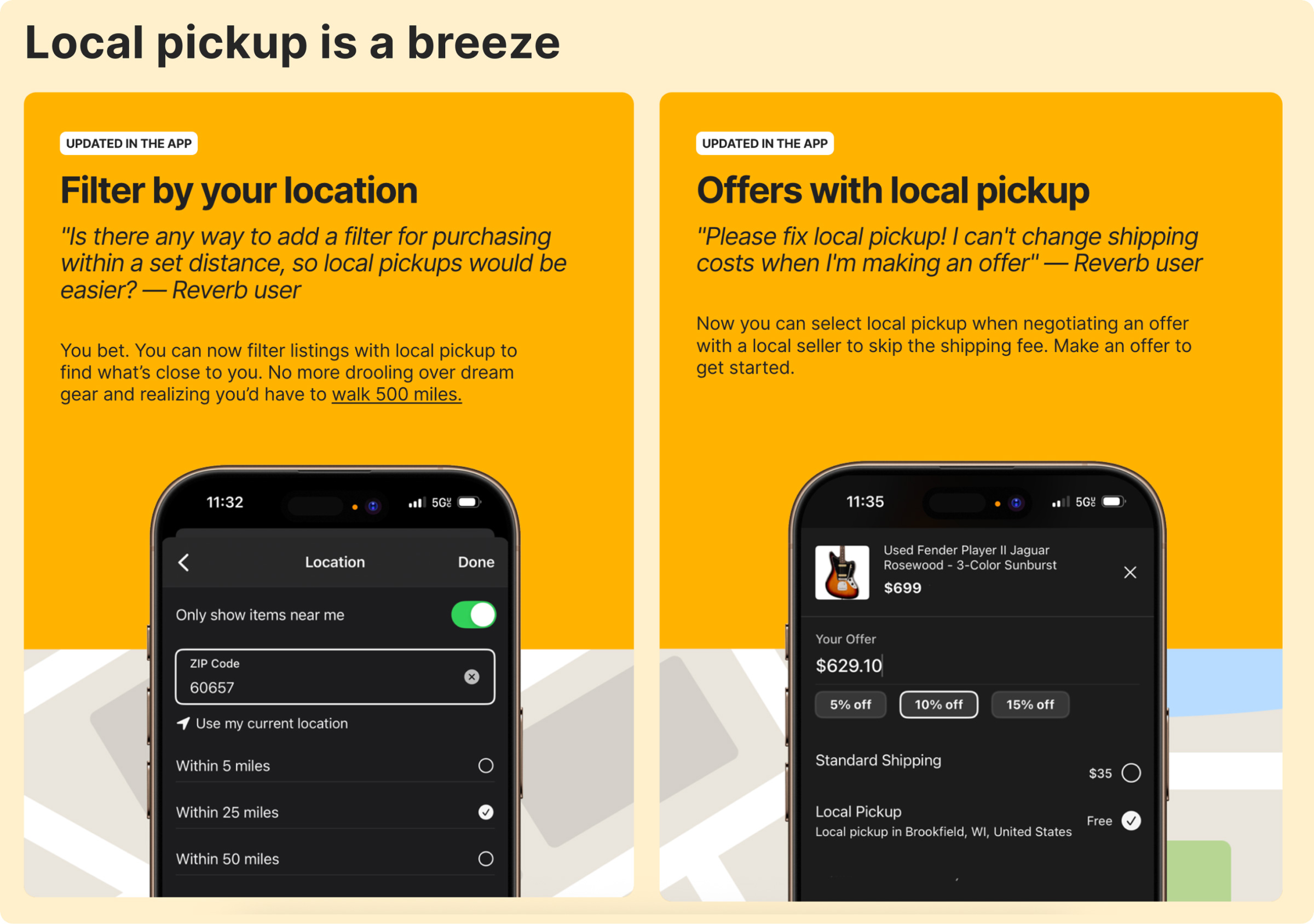
As a team, we felt confident that this work addressed a long-standing problem for our users rather than an experimental optimization. We chose to ship the updates as “no regrets” releases instead of running an A/B test, focusing our efforts on clearly communicating the change through in-product tooltips and a feature callout in Reverb Releases, our quarterly product update newsletter.
Post Launch & Follow Up
Following launch, we saw a steady increase in local pickup orders and a immediate noticeable drop in complaints related to local shopping in app reviews—strong signals that the new experience was better meeting user’s needs.
From the increased interaction with local listings, we discovered that the app had actually never supported the ability to opt for local pickup when making an offer on a item, so we followed up the other updates with a quick sprint to add the feature for even more local shopping love.
